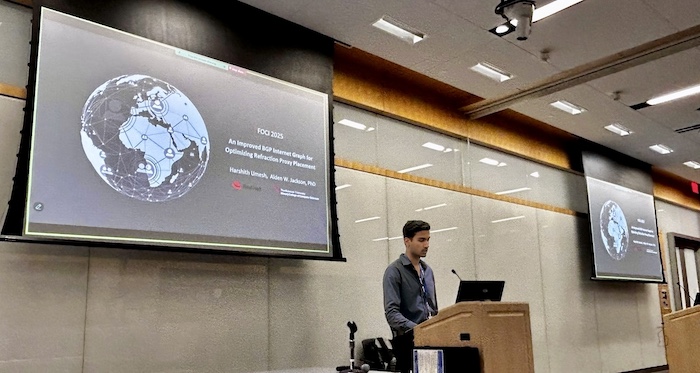
Harshith Umesh, Red Hat Research intern turned Red Hat employee, recently presented the paper “An improved BGP internet graph for optimizing refraction proxy placement” at FOCI 2025, a premier conference on internet security and censorship. Harshith worked with Northeastern University professor and co-author Alden Jackson as part of the Research Apprenticeship Program at Northeastern’s Khoury College of Computer Sciences.
In the paper, the authors construct the first censorship-aware Autonomous System (AS) + Internet Exchange Point (IXP) multigraph to conduct coverage analysis for the five most censored countries (as identified by Censored Planet): Turkmenistan, China, Iran, Oman, and Afghanistan. Their work presents a scalable framework for censorship-aware internet topology analysis aimed at providing empirical insights for designing more resilient and targeted systems to circumvent censorship.
The current work identifies ASes and IXPs most suitable for deploying Refraction Networking (RN) proxies within specific countries. Future work could extend this framework to optimize proxy placement for global coverage, minimizing the number of RN proxies needed while maximizing the number of censoring regions covered.
Harshith spent two years as a full-time Red Hatter in India before coming to Northeastern as a graduate student. He completed his Master of Science at Northeastern in May 2025. Harshith is now a Performance and Scale Engineer at Red Hat, specializing in building and optimizing LLM inference at scale.
To learn more, see “An improved BGP internet graph for optimizing refraction proxy placement” in the FOCI proceedings.