


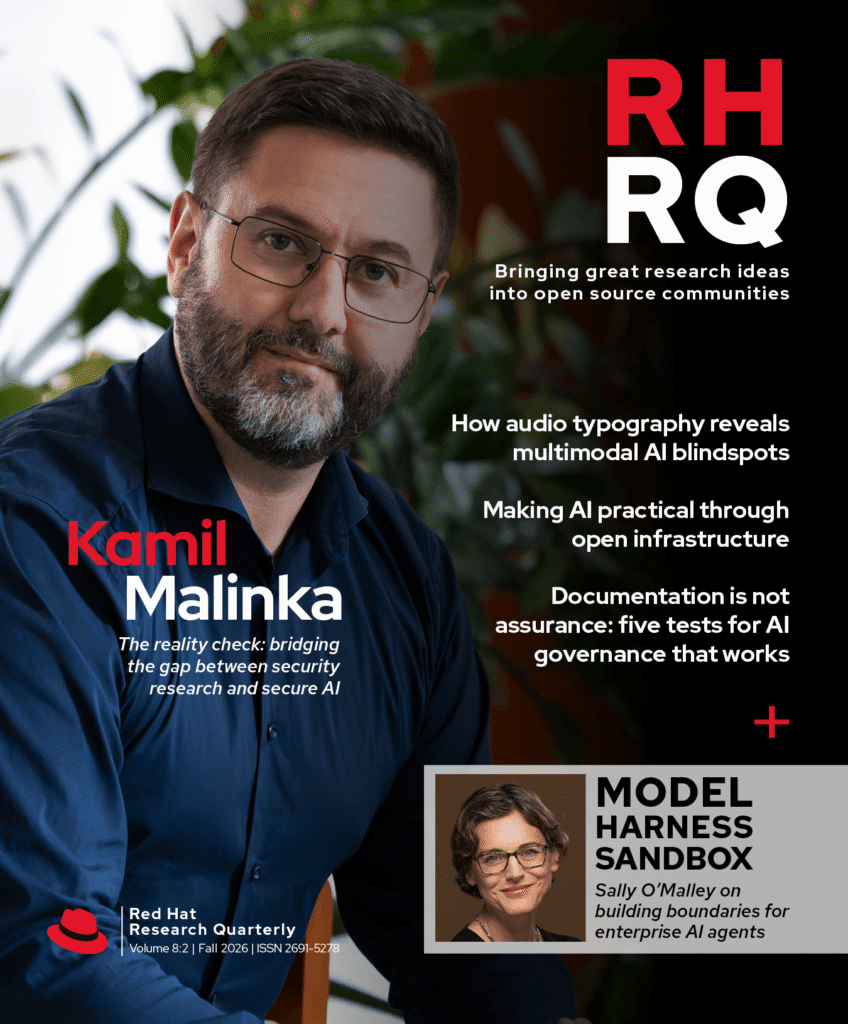







Reviewing the Fall 2026 RHRQ slate, I discovered we’d created a security-themed issue without meaning to. From news about the AI safety project asago to an interview with one of the leading university security researchers in Czechia, this issue is addressing the challenges and opportunities of secure AI from multiple angles.
Though that theme wasn’t intentional, it’s not surprising. Recent AI research trends suggest we’re headed into a new phase. We’re still asking, “How much can we make this tool do?” but adding “How can we be sure this tool does what we say—and only that?” For example:
Setting AI agent boundaries
OpenClaw maintainer and Red Hatter Sally O’Malley digs into this question from a very timely perspective. OpenClaw became one of the most popular open source projects on GitHub because it is a powerful agentic assistant. That makes it a terrific use case for understanding the role an agent harness and sandbox plays in making an open source tool enterprise ready. Read her article, “Harness, meet sandbox: what OpenClaw teaches us about AI agent boundaries for enterprise” to learn more.
Trusting AI output
As researchers are making AI output more accurate through smaller, more specialized models, Retrieval-Augmented Generation, and other methods, malicious actors are developing ways of using AI to bend the truth. Kamil Malinka, who heads the security research group at Brno University of Technology, Czechia, discusses deepfakes, knowledge-editing attacks, and other ways of getting LLMs to misbehave in “The reality check: bridging the gap between security research and secure AI.” Boston University professor Deepti Ghadiyaram examines the risks posed by audio typography attacks in “When speech lies to the camera: what audio typography reveals about multimodal AI’s blind spots.”
Verifying what you think you know
Malinka’s security team is working on another line of exploration with Red Hat researchers: an AI Bill of Materials (AIBOM). “For me,” said Malinka, “the key question is not whether we can publish an AIBOM, but whether we can actually trust what is in it.” For that, researchers are building and testing the tools to verify AIBOM claims. Also in this issue, Red Hatter Andy Mott, Senior Consultant at Red Hat UK, responds to an earlier RHRQ article on AIBOMs by Marek Grác and Martin Ukrop (“Unpacking AI’s black box: why authenticity and traceability must be built in,” RHRQ Winter 2025-26). Mott argues that an AIBOM is just one layer in an effective AI governance strategy in “Documentation is not assurance: five tests for AI governance that works.”
Ensuring sustainability and efficiency
It’s impossible to talk about AI safety without talking about the impact of AI workloads on energy systems. We’re happy to feature Red Hatter and Columbia University Visiting Scholar Vincent Caldeira’s column “Aligning research and cloud-native practice: a systemic approach to sustainable computing,” which presents findings from a comprehensive study undertaken with colleagues at IBM Research. Caldeira mentions algorithmic efficiency as one path to greater sustainability, a challenge researcher Eldar Kurtić discusses in “Making AI practical through open infrastructure.” Kurtić calls our attention to several open source projects aimed at taming AI efficiency bottlenecks.
As Malinka points out, we are at the early stages of answering these questions, and we depend on researchers to keep looking for the questions we still need to ask. And that brings us back to where we started: the community around AI Safety and Governance Orchestration (asago). Participants in this multi-organizational effort have made it plain that industry, community, and universities must come together to address AI safety challenges, because no one organization can do it individually. Projects like asago ensure that solutions maintain freedom of vendor choice, prioritize transparency, and maximize user benefits—critical components of trust for AI systems.
Is there a question you’d like to see addressed in a future issue of RHRQ? Share feedback and ideas at rhrq@redhat.com.