










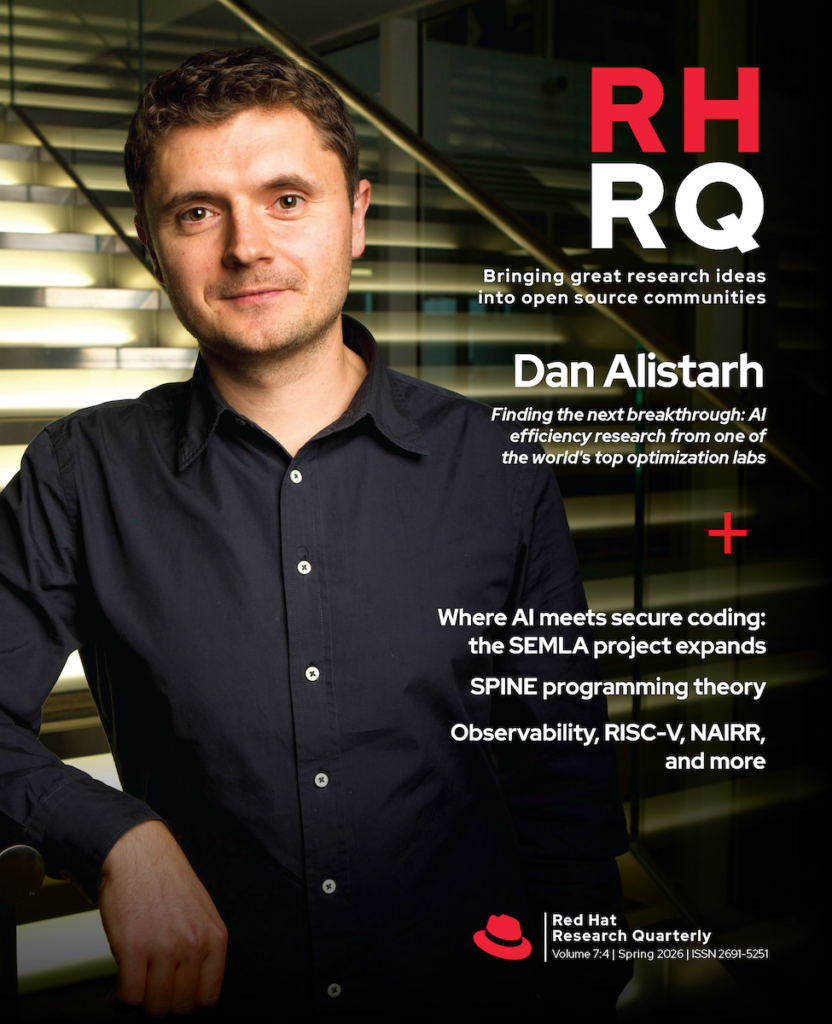
Often in RHRQ, we look at the work of people discovering new frontiers in technology, but what I hope makes us different from other technology journals is that we’re also asking how open source and open practices can make these discoveries accessible to people in the real world.
This issue’s interview spotlights Nir Shavit and Dan Alistarh, a leader in AI efficiency. Dan’s work on quantization and sparsity is fascinating because it’s about more than just speed; it’s about making massive models run on standard hardware so that advanced research doesn’t stay locked behind a paywall of expensive GPUs.
Other articles explore the practical “how-to” of this evolution. Isaiah Stapleton dives into observability for LLMs on the Mass Open Cloud, while Dr. Simone Ferlin-Reiter shows how the SEMLA project uses AI to catch code vulnerabilities before they become problems. We also feature a look at SPINE Programming Theory (SPT) from engineer Christopher Tate and his collaborators in the Smart Aquaculture project, Dewayne Branch and Denis Poussard. SPT is a framework allowing developers to write only 2-4% of the code for data-driven websites while AI handles the rest, and it’s been used for digital twin projects, AI telemetry monitoring, and businesses looking to reduce their manual computing labor.
These stories prove that open source is the most effective engine for AI innovation. By keeping research transparent and collaborative, we ensure these tools remain a shared resource—and speaking of shared resources, be sure to catch up on what’s happening with NAIRR (the US National Artificial Intelligence Research Resource) in Heidi Dempsey’s letter from the director, “Pushing the boundaries of AI development.” Heidi’s description of NAIRR’s progress is really an apt summary for the journey we’re all on: “The challenges remain significant, but the results thus far have been very exciting.”