











Developers using SPINE Programming have drastically cut manual coding time while maintaining full control over their data.
SPINE Programming Theory (SPT) is a form of on-device, local AI code indexing and generation that accelerates software development while ensuring that users maintain full control over their data in their own environment. SPT allows developers to focus on business logic—like the OpenShift Observability models for Red Hat ACM hubs, clusters, nodes, devices, projects, VMs, and cluster requests—by providing easy-to-follow rules in code comments for defining data models and webpages for creating, accessing, and modifying data. Developers can use SPT across vastly different domains to take an unimplemented key performance indicator (KPI), like GPU device utilization, and quickly make it into a data-driven website in OpenShift AI workbenches or on their own computer and deploy it to the cloud. Creative developers and small businesses are learning how to use the extreme productivity of SPINE Programming to develop, implement, and sustainably maintain interactive websites in areas ranging from aquaculture and agriculture to datacenter management.
The heart of SPT is a local AI agent watcher service, provided by the Java java.nio.file.WatchService, that monitors a programmer’s project directories for file creation and modification events. A cluster manager for distributed applications deployed in OpenShift Local or an OpenShift project provides file-locking capabilities when generating multiple code files at the same time without conflicts. This scalability means that multiple developers can share the same cluster manager while working jointly on a project. The service uses an open source search engine also deployed in OpenShift to store a complete structured code index of local code parts as they are added or modified. The event-driven watcher service also performs introspection on the code and generates the data model, database schema, Java API, OpenAPI, JavaScript, and website templates directly on the developer’s computer or OpenShift AI workbench. As a result, SPINE Programmers write only 2–4% of code by hand on average, while the other 96-98% of code is AI generated, resulting in software development that is 33 to 50 times faster.

In Red Hat Research, we used SPT to develop AI Telemetry—a multitenant observability platform deployed on the Massachusetts Open Cloud (MOC). This application allows us to grant fine-grained access to OpenShift metrics, dashboards, and APIs at the organization, hub, cluster, and project levels for MOC users. We created the initial commit for AI Telemetry in less than a day during a meeting in Boston, adding the first data models—including AiCluster, AiNode, GpuDevice, Gpu, GpuSlice, AiProject—and webpages for creating, accessing, and modifying data for the project. Because of the speed of SPT, Chris could model these during discussions of business requirements for AI workloads and observability after lunch and demo the application at the end of the meeting. A review of the word count scripts for AI Telemetry shows that the ratio of handwritten to SPT-generated code sits comfortably within the average: 10,938 lines of handwritten code and 290,844 lines generated by SPT. Red Hat Research engineers wrote only 3.62% of the AI Telemetry code in this example.
We are presenting our research paper on SPT, “API Code Generation of Zero Trust, Data-driven Websites, Digital Twins with SPINE Programming Theory,” at the Northeast Decision Sciences Institute (NEDSI) conference in Philadelphia, PA, April 9-11, 2026. The conference theme—Future of Decision Sciences: Complexity, Innovation, Sustainability—focuses on evolution of the field of decision sciences (e.g., data analytics, cognitive science, and AI) and the role it plays in addressing modern organizational and societal challenges. In this article, we will explain the background to SPT, discuss use cases for business and environmental challenges, and provide resources for developers. To learn more, and to see more examples of code comments, see the full paper.
SPT: origins
Chris’s journey building data-driven websites began while he was earning a Bachelor’s degree in Computer Science in 2005. He practiced his skills by building a site for Trail Blaze Hunting Consultants. Initially written in XML and XSLT, the site required manual labor for content updates: they would send Chris content, and he would put the information into XML format and update the site. A few years later, the site provided early lessons in access control, which was a rough but crucial start. The project also taught him about deployment, as he first hosted the site from his university apartment on a Windows laptop. Over the years, the site was ported to Java and scaled from his personal devices to Red Hat OpenShift Online and is now hosted on Google Kubernetes Engine.
SPINE Programming began with Version 1 as purely XML in the early days of creating HTML documentation. V2 was a complete rewrite to develop websites as Apache Tomcat Java applications, with a backend authorization service, database, and search engine. V3 moved entirely to Java to overcome the difficulties of XML automation, enabling faster code generation and modeling for data-driven websites. V4 introduced the key watcher service functionality, which automatically detects file creation and changes and generates desired code by extending a non-existent superclass to be generated after the code is saved. V4 also leveraged advanced Java features like generics and static typing. V5 added multi-language support (French and English), and V6 incorporated Java Vert.x asynchronous API code generation for building scalable, reactive, cloud-based applications based on Promises and Futures.

getting homework done so he can code with SPT
An illustrative story about the value of SPINE Programming comes from Little Orchard Preschool, where Chris’s child was once a student. The owner asked him to build an online enrollment and payment tool to manage her school—a project he completed in six months in his spare time. She laughed when she heard that the software could handle multiple locations, as at the time they only had one, in Bountiful, Utah. However, the site’s success was immediate: after a huge jump in 2017 enrollments, the school opened a second location in Farmington in 2018, a third in Kaysville in 2019, and even managed a virtual preschool during the 2020 pandemic. This system, which included separate enrollment forms, Authorize.net payment integration, payment histories, and helpful reports, lists, and printouts, proved so successful that she was able to sell the preschool to new owners—a real-world demonstration of how SPINE Programming helped her business grow.
While this story demonstrates the value of SPT for small businesses and rapid scaling, the principles of efficient code generation and security extend to solve much larger, more complex challenges for enterprise and digital twin environments.
SPT for enterprise
SPINE Programming addresses many challenges faced by businesses seeking to modernize rapidly, adapt more quickly, and reduce costs. These are just some of the examples enumerated in our conference paper.
Code indexing
The growth of repositories, libraries, and code dependencies has made code indexing a significant challenge for modern software systems. The SPT watcher service is also a Java code parser based on the QDox Java library that indexes syntactic structure, semantic meaning, and contextual relationships between components, providing abstract syntax trees, control flow, and data dependencies of code into an open source search engine as Java code is created or modified.
Code generation
A local SPINE agent watcher service watches the programmer’s code project directories for created and modified file events. Code generation occurs during these events, automatically producing executable code from high-level requirements, with correctness, security, maintainability, and alignment with user intent that actually compiles and runs. Because the platforms we’ve built with SPINE Programming contain 96-98% SPINE-generated code on average, software development productivity increases up to 4900%—essentially the elimination of 49 hours of manual coding for every one hour of creative engineering.
Declarative order of constraints
Because data models often have dependencies on other data models, an order of constraints must be applied to the models and model fields defined in SPINE Programming projects. This ordering is essential for ordered normalized database schema definitions, ordered user interface navigation, and ordered Open API Schemas. Order is achieved by adding an Order comment or separate SqlOrder comment in the Java class.
Database schema generation
Improperly designed database schemas can significantly reduce performance, scalability, and data integrity over time. With SPT, a database schema maps unstructured input into normalized schemas without introducing redundancy or inconsistency. Java classes that extend a BaseModel class can add Persist: true comments in SPINE methods to persist tables and columns in the database.
Open API generation
OpenAPIs describe RESTful services in a standardized and machine-readable format and can be automatically generated with SPINE Programming to maintain synchronization between implementation and documentation, ensuring accurate data models, and clearly expressing endpoint behaviors. ApiMethod comments declared in Java model classes automatically create Java API backends and matching OpenAPI specifications.
Modeling business challenges
SPT models customer needs and business challenges with sustainable speed of operation and lifecycle management, proven sustainable in enterprise, digital twin, and event-driven environments. Businesses have key performance indicators (KPIs) that they need help to model and optimize as Java APIs. SPT automatic generation of Java APIs writes API interfaces that are both functional and intuitive for developers. All generated APIs can easily be overridden, extended, or reimplemented for KPIs using object-oriented concepts, simplifying software adoption and long-term maintenance.
Zero-trust access control
SPT uses zero-trust fine-grained access control principles, where the system assumes that no component should be inherently trusted. Systems must continuously authenticate and authorize entities while maintaining usability and performance. The usual challenge of fine-grained security policies of identifying user groups, behavioral patterns, and permissible access levels is made easy with SPT, by declaring access control AuthGroup and Scope comments in the Java data models.
Real-world research
Data models can grant access to any number of different tenants, providing multitenancy and strict data isolation across models with AuthorizationResource comments in the code. AI Telemetry (described above) demonstrates SPT’s multitenancy and data governance across various levels (hub, cluster, project, organization) in a distributed, global environment. On the MOC, developers across continents are able to fork and develop their own contributions to this project in individual VSCode development workbenches in the cloud.
SPT has also advanced collaborative social innovation projects. For instance, a research collaboration with Boston University and the Red Hat Social Innovation Program used SPT to create the global, secure, open source research platform Smarta Byar Smart Village for studying social sustainability in Veberöd, Sweden, using actual data from Veberöd (or its digital twin) as a test village. Chris also used SPT in collaborative projects with the Southern Coalition for Social Justice (SCSJ). They developed the Racial Equity Report Cards website, which acts as a call-to-action for students, parents, advocates, policy-makers, and institutional stakeholders to collectively examine the causes of racial inequity in their community and to develop solutions, and the Open Data Policing website, which allows users to monitor enforcement patterns, the frequency and efficacy of searches, and racially disparate practices.
Smart aquaculture
In France and across Europe, both the Atlantic and Mediterranean maritime zones face interconnected challenges: climate change, biodiversity management, fisheries sustainability, and aquaculture optimization. The Smart Aquaculture platform is a digital twin for fish populations, fishing boats, and fishing docks that helps users manage intelligent fisheries for better efficiency and sustainability through smart devices. SPT enables the creation of structured, interoperable digital systems that can connect data, models, and services across these different marine environments. The platform is 2.2% (5,527) lines of handwritten code, with 97.8% (249,859) lines of AI-generated code through SPINE Programming.
SPT enables the creation of structured, interoperable digital systems that can connect data, models, and services across different environments.
By using modular and scalable architectures, digital twins and monitoring platforms can integrate sensor data, environmental indicators, and simulation models from both regions into a coherent framework. This integration supports comparative analysis, coordinated resource management, and shared technological innovation. It allows scientists, engineers, and policymakers to develop unified decision-support systems while respecting regional ecological differences. Through SPINE-based architectures, Atlantic and Mediterranean marine systems can be linked into a resilient and collaborative digital ecosystem for sustainable ocean management.
Qatar Strategic Business Group (QSBG), headed by Dewayne, is a collaborator in the Smart Aquaculture platform. QSBG has found SPT to be a powerful compute paradigm, taking an abstract KPI and making it into a real deliverable for a customer or partner, which is essential to strategic business activity and justifying resource investment. Especially for a small business, preventing vendor lock and providing a clear business workflow from idea conception to sustainable operations has made SPT a valuable tool, along with the ability to set digital simulations on spatial models and engage in custom and multilingual customer operations. QSBG has also found SPT helpful for modernizing cyberinfrastructure pathways, while its digital twin capabilities have provided tools for analysis and cost reduction.
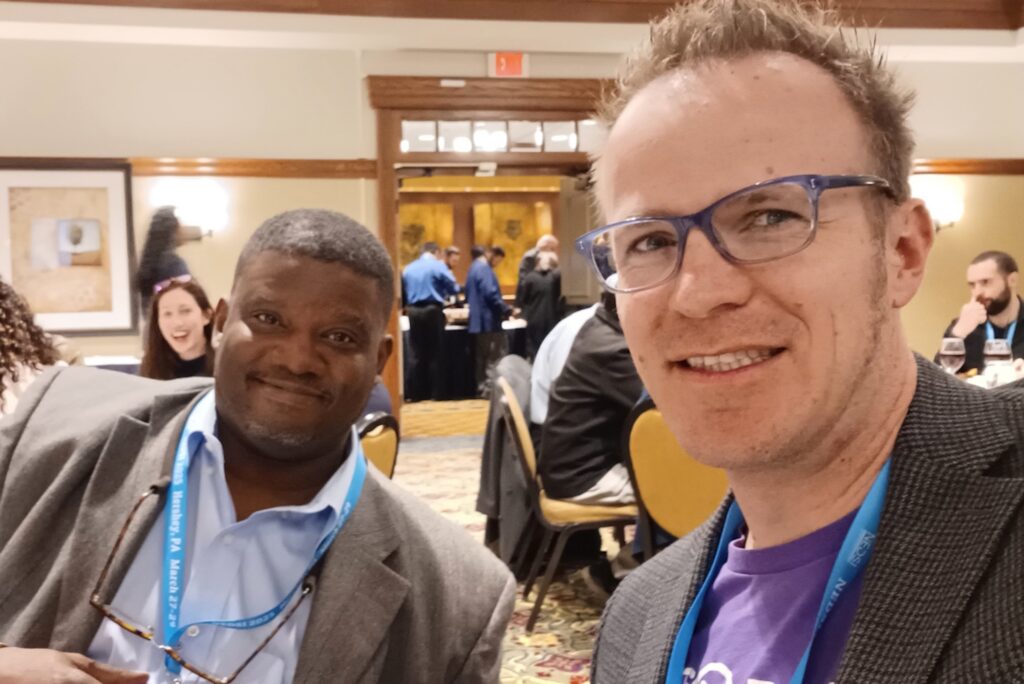
According to Dewayne, QSBG is going all in on SPT research, innovation, implementation, and market development. SPT has helped QSBG achieve multiple milestones in business and research success: presentations and conferences including Red Hat Summit and RIOT, open source venture capital preparation support, and years of North East Decision Science Institute submissions, development, and publication acceptance, to build an open source brand with global potential. SPT also allows QSBG to successfully support its customer, the Green Reef Foundation (also a Smart Aquaculture collaborator), with great success, support, benefits and solutions.
Learn more
SPINE Programming is a recursive acronym that stands for “SPINE Programming is not easy” because of the depth of knowledge required to be a SPINE Programmer—which is the purpose of this research. We invite other programmers to explore SPT and find out how much they can increase their productivity. On average, the websites brought online with SPINE Programming go from business concepts to development to production in six months.
Find more information at spineprogramming.com and join us April 9-11, 2026, at NEDSI 2026 with other scholars and practitioners interested in applying quantitative and behavioral methods to social problems through emerging technology.