

Red Hat Research Quarterly
Stop talking, start doing: how universities rise to the challenge of the AI revolution
Red Hat Research Quarterly
Stop talking, start doing: how universities rise to the challenge of the AI revolution
about the author

Sherard Griffin
Sherard Griffin has over 20 years of experience architecting and developing large-scale enterprise data and AI solutions. He has been at Red Hat since 2017 and is currently the Senior Director of Engineering for Red Hat OpenShift AI. He is also responsible for Open Data Hub, a community-driven open source project for building an AI-as-a-service platform on OpenShift. He works with hardware and software partners to build out an ecosystem of AI technologies optimized for Kubernetes, Open Data Hub, and OpenShift AI.
Article featured in

In this issue




Mingzhi Zhu

Stacy Patterson

Michele Merler

Raju Pavuluri
Yunshi Wen

Wesley M. Gifford
Chandra Reddy

Lam M. Nguyen

Jayant Kalagnanam

Anak Agung Julius

Sai Sindhur Malleni

José Castillo Lema

Raúl Sevilla Canavate

André Bauer

Aleksei Vasilevskii

Simon Sundberg

Simone Ferlin-Reiter

Anna Brunstrom

Toke Høiland-Jørgensen

Jesper Dangaard Brouer
The conversation around AI in higher education sometimes feels stuck in abstraction. When industry and academia work together, however, that conversation is immediately grounded in things like the transition to data-driven engineering, the necessity of academic agility, and the hard work of building infrastructure that is reliable, auditable, and open.
North Carolina State University Provost Jim Pfaendtner provides a front-row seat to how a major research institution navigates this transition. Jim brings a rare dual perspective to this challenge—a career rooted in the computational chemistry lab at the University of Washington and an administrative track that prioritizes the rapid adaptation of engineering curricula. (Note: This interview was conducted prior to Jim’s appointment as Provost; he served as Dean of NC State’s College of Engineering from 2023-2026.) The conversation is led by Sherard Griffin, Senior Director of Engineering for OpenShift AI at Red Hat. An NC State alum, Sherard brings a personal connection; having walked the Centennial Campus himself, he understands that the best partnerships aren’t transactional—they are deeply integrated. This is the cornerstone of Red Hat’s AI University Partnerships: creating a collaborative environment where industry and academia can turn experimentation into operational reality, to make AI scalable, secure, and accessible to everyone.
—Shaun Strohmer, Ed.
Sherard Griffin: You come from a background in both chemical engineering and computer science, which means you stepped into the computational side of science and the world of data and AI before it was cool. How did those worlds meet for you?
Jim Pfaendtner: I am in some ways a poster child for what we now call interdisciplinarity. I got my undergrad in chemical engineering, and I worked at a hands-on job at 3M doing process engineering for fluorochemical processing. When I went to grad school, I was captivated by the idea that you could do computational science for your PhD and the computer could be the thing doing the experiments for you. My PhD was in the area of computational chemistry and computational modeling of chemical reaction networks—everything from the physics of how molecules work to graph theory representation of large networks of chemicals. Tons of overlap with computer science when you get to that side of the spectrum.
The next big pivot for me was into machine learning and AI, which I still use heavily in my research. Back in the early 2010s, lots of grad students at the University of Washington were coming to me and saying, “There’s this job called Data Scientist, but they won’t give me an interview even though I’m pretty good at computers and I know statistics.” That was an opportunity to reframe and update the curriculum for graduate students in chemical engineering and material science. We were one of the first departments to build out a comprehensive machine learning and data-driven curriculum for chemical science, material science, and chemical engineering. I’ve been actively involved in my research group in the use of data-driven models—deep-learning models at first and now generative models. One of my current PhD students is working on Adaptive Reasoning Models right now for chemical and molecular discovery.
Sherard Griffin: How do you see this accelerating work in the computational sciences or chemical engineering? What is it allowing people to do that they couldn’t do before?
Jim Pfaendtner: That’s what makes me so excited right now. At NC State, we have people in all the disciplines working at that interface of data-driven engineering, machine learning, and deep learning. We have autonomous and self-driving labs with incredible expertise. In biomedical engineering, we have exoskeletons trained by deep learning and AI models to enhance well-being and quality of life for people who might be paralyzed or healing. I could go on and on—some faculty member is going to hear me and say, “Hey, you didn’t mention me,” but every department has these incredible strengths right now. We are by far the largest college of engineering and computer science in the state of North Carolina, and it brings together a massive amount of talent.
Sherard Griffin: I want to ask about your background, but first, tell me about your last name, Pfaendtner. What’s the history?
Jim Pfaendtner: The family name is German. We looked up its origin and learned the Pfaendtner was like the repo man in the Middle Ages. If you got a payday loan and you didn’t pay it back, the Pfaendtner came and broke your legs. Still in Germany today, if you pay a bottle deposit, it’s called the “pfand.”
Sherard Griffin: How did you get into engineering and computing?
Jim Pfaendtner: I grew up loving science and technology—I was obsessed with computers. Then I went to an engineering summer camp at Georgia Tech and I never looked back—I fell in love with Georgia Tech and went there as an undergrad. I moved to NC State three years ago from the University of Washington, where I started my professional academic career. Just like industry technical companies, universities have technical tracks and leadership tracks. I switched to the administrative leadership track about eight years ago, and I have loved academic leadership and all the opportunities that come with it.
Sherard Griffin: What’s that first computer you had? I think we all have fond memories of someone saying, “Hey, here’s this cool box you need to start playing around with.”
Jim Pfaendtner: My family came from humble means. We had an Atari, but you can’t do much with it. Then my dad brought a desktop PC home from work, and within a week I took the whole thing apart. I got a screwdriver, slid the big case off, took the processor out of the motherboard, laid it all out on the table, and I had no idea how to put it back together. I got in a lot of trouble.
Sherard Griffin: Of course. Here’s what could be a controversial question for our readers. What was the operating system on that first machine?
Jim Pfaendtner: Oh, no question. It was MS-DOS, probably 4.0.
Sherard Griffin: Nice. What was your first thought going from DOS/Windows to Linux?
Jim Pfaendtner: It was hard to understand what it was at first. It was really a revelation. My uncle worked at NASA, and as soon as he realized I had a modem, he taught me how to log into a supercomputer he ran and how to use email. It was very much a novelty as a 10th grader to load Pico and send my uncle an email using Pine. In retrospect, he probably shouldn’t have given me that account. I don’t think it would pass cybersecurity training today to give your nephew five states away an account on a supercomputer, but it was the wild west back then.
Teaching AI for the next generation
Sherard Griffin: It feels like the wild west now, too. What are some of the challenges you’re seeing on the academic side of AI?
How are we teaching brand-new freshmen to think about AI?
Jim Pfaendtner: Big public mission-focused land-grant universities like NC State, we’re built like tanks. We’re built to produce results for the state and to be reliable institutions that serve. Yet at this moment, being agile is essential. Every August, we’re welcoming about 1,850 brand-new freshmen into the College of Engineering. How are we teaching them to think about AI? We’re trying to figure out the minimal set of ideas, concepts, and hands-on experiences college freshmen need to begin to think about the engineering design cycle. That’s why we have a comprehensive freshman experience, and we’ve worked hard over the past two decades to build it because we know it leads to better outcomes for students and better engineers.
But because we built that big durable thing, we’ve got to figure out, where does the dose of AI come early on and then where do we keep redosing it to reinforce it? In higher education, you’ve got to learn the concepts of something, you’ve got to practice it in a structured and safe way, and then you’ve got to get some dirt under your fingernails and do some real projects. Of course, they’re using AI all the time already, but it’s essential that we guide them in appropriate ways to do it, and that we guide them to do it in an engineering-forward, computer-science-forward way, so the fundamentals are still there.
Sherard Griffin: I think that’s exactly right. We do a lot of work with early talent—interns or newly hired engineers—and we’re changing the tires as we’re driving. One of the things we’re seeing is, yes, you absolutely have to have the fundamentals, because if you’re just telling AI what to do, but you don’t understand how to debug, how to investigate whether you’re exposing something from a security perspective, or how to ask the right questions, you’ll be in trouble. If you just passed the course and didn’t really pay attention, then man, by the time you figure out what AI is doing, it may be too late in your development process.
Jim Pfaendtner: 100%. You can’t replace the time and space a college student has to learn fundamentals and critical thinking. Even biologically, we know you can’t replace it because the brain is, for lack of a better term, hardening. Students start learning at a slower rate. Their ideas and concepts about problem solving become somewhat calcified over time. We take this seriously, and we’re lucky to have so many faculty who care deeply about this and are eager to jump in. I’ve heard near zero complaints from faculty about the use of AI—just incredible enthusiasm. Everything from incorporating it into the curriculum to making their jobs easier.
Sherard Griffin: Speaking of faculty: how has coalescing around AI changed your approach to faculty, either on the training side or the recruitment side?
Jim Pfaendtner: You won’t be surprised that the early-career faculty we’re hiring right now—maybe it’s their first faculty job, maybe they’ve been one or two years somewhere else—are coming with all kinds of ideas for AI already, so we don’t have to do much other than get out of the way. But we have faculty at all stages of their career. Where do we create that space for faculty to upskill? Industry does this well. The value proposition in industry for employee retention and employee upskilling is really clear. Higher education is not known for being particularly effective at this.
We’re launching a program right now to create a faculty fellowship program so people can step away on their sabbatical with the explicit purpose of upskilling in AI. For example, we have a faculty member in civil and construction engineering who is going to learn how to use AI to support her research in water quality, and the other stories are all equally motivating. These individuals will come back with amazing ideas for new classes, new research projects, and new grants.
Industry partners and open source
Sherard Griffin: I’d be remiss not to mention the partnership between Red Hat and NC State—me being an NC State alum. I remember being a student on NC State’s campus and Red Hat’s headquarters was right down the hall from some of my classes. My AI class on Centennial Campus was my first foray into AI. What do industry partnerships mean for the College of Engineering? How can a company like Red Hat help with some of the goals you’re trying to achieve?
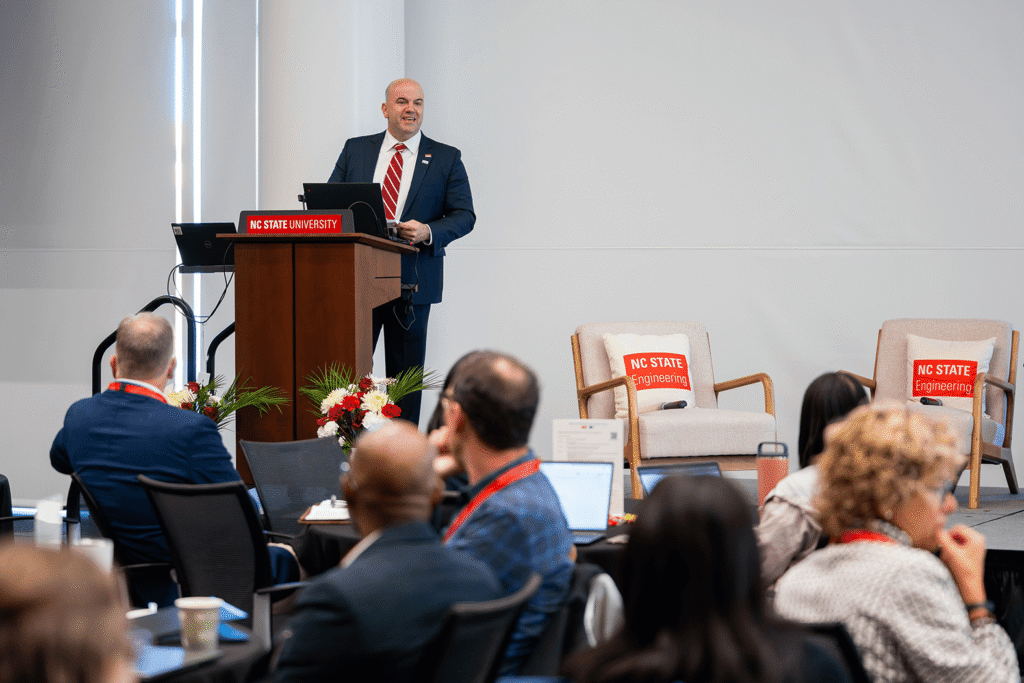
Jim Pfaendtner: We say it loud and we say it often: we’re a public land-grant institution. In the College of Engineering, that means we partner with companies, nonprofits, and government. In the company space, most of our graduates go work in the private sector. We have a responsibility to engage deeply with companies and it’s a two-way street. Companies get access to the best talent, but they’re also giving ideas to our faculty and administrators. That’s one of the first things you and I talked about: you asked me, “How are you going to approach the agentic software engineering problem and incorporate that into the classroom?” and I said, “Well, I’m going to approach that by talking to Red Hat more with you.” If we don’t do that, we’re missing a huge opportunity. The coming years are going to see a deeper engagement of companies in this type of arrangement, especially given the way the federal portfolio is changing, and the companies that are first at the well are going to get a lot out of it. I’m excited to continue structuring those relationships and working with companies that want to partner with us, because it’s going to be great for everybody.
Sherard Griffin: At Red Hat we do something called open source—I don’t know if you’ve heard of it.
Jim Pfaendtner: Yeah, a little. <laughs>
Sherard Griffin: What does open source mean to you? How did you get experience with it personally, and then how does that apply to the College of Engineering.
Open source means we publish our work first.
Jim Pfaendtner: It was my first year in grad school, and I got a new computer. You give a new student a new computer, and they say, “Install RHEL.” I was like, what’s that? Northwestern had a site license for Red Hat Enterprise Linux, so that taught me the benefit of an open source concept where you licensed access to libraries and software. I built my own cluster and installed Rocks and the operating system on it when I was a grad student—24 nodes!
But especially for people who do interdisciplinary work in physical and engineering sciences, open source means we publish our work first. I have never been the lead on a patent as an academic, but I’ve been part of over $40 million of research grants as PI or Co-PI, and that has led to probably 150 peer-reviewed publications coming out of the Jim Pfaendtner research group.
The amount of tech transfer that occurs is a huge benefit of the federal investment in research.
In the knowledge economy, publications are the open source way we transmit information. That’s changing a little bit with this rapid rate of production of new information with AI and autonomous science, so publications might look different, but federal funding agencies require things to be open source. They require publication and free access to many types of products that come out of grants. So my bent has always been that I’m going to disseminate knowledge first, and then if I get involved in technology transfer or commercialization, that’s fine. I support that, and many important startups have come out of universities. The amount of tech transfer that occurs is a huge benefit of the federal investment in research. But alongside that we also have to have open source software, open source research in AI, and open source dissemination of knowledge from all of our labs.
Sherard Griffin: It used to be if you were doing something AI, you needed access to a supercomputer and you submitted a job—maybe it was running on Slurm—and it took a while and then you got some results back. What has open source done to AI to make it more accessible?
Jim Pfaendtner: The push to make models smaller, more computationally affordable, to use less energy, all of that, is creating downstream benefits on campus. A lot of what we do in teaching students doesn’t need the latest or even the previous generation of quality. An engineering example is the drift away from MATLAB toward Python over the past 15 years. Many more engineering classes are now using Scientific Python, Python, NumPy, etc. because it’s free and open source. I taught with MATLAB; I learned MATLAB as a student. When I went to work at 3M, I needed to solve a problem and I asked for a MATLAB license. They were like, “We’re not buying that.” It was an aha moment for me when I was a young process engineer. So when I was department chair at University of Washington in chemical engineering, we wholesale switched all software to open source. Every class solved chemical engineering problems using Python. It was a bit of an abrupt shift, but we got through it.
Don’t just talk about AI—do it
Sherard Griffin: Your work gives you a view across various domains in the College of Engineering. What are some of the areas you’re most excited about?
Jim Pfaendtner: I just came from Washington DC at a gathering of engineering deans, a policy forum. Every year there’s an hourlong panel on AI, and it’s an echo chamber saying, “We need AI, we need to teach AI, we need to do AI.” We need to stop saying “You have to do AI” and dig into, “What are you doing? How can we work together?”
The thing I am most excited about in engineering is the way we are going to transform engineering design.
The thing I am most excited about in engineering is the way we are going to transform engineering design. A specific example would be a structure design in the civil engineering department. The way structural design is conducted has been largely unchanged since we’ve started building: before we were writing things down, we intuited physical laws and learned how force is distributed, then we wrote down those mathematical equations after Newton and we began to design around that, and then in the past 20-30 years we’ve used finite elements and supercomputers to enhance the way we design structures.
But at the end, it’s an acceleration of the same thing. We’re solving mathematical equations based on physics-based models. Now, data-driven models are emerging. We are going to get new insights on structures simply by processing the data of all structures humans have ever created and how those structures work. And as we continue to add more sensors on things, that is going to rapidly accelerate. A Microsoft researcher in 2009 called this The Fourth Paradigm. The Fourth Paradigm is starting to touch many traditional engineering disciplines, and it is going to revolutionize things.
Sherard Griffin: That’s a great example of one of the unsung-hero types of stories about how AI is helping people sift through massive amounts of data that have been collected over the course of 20-30 years. We used to have these big analytical engines, and you would have to know the exact question to ask the unstructured data to get value out of it. Now, we’re getting to a point with AI where it’s helping bridge that gap. I may not know exactly what to ask, but I’m able to get through all of this data, whether it’s structured or unstructured, and it can infer what I mean from somebody or even recommend, hey, is this really what you want to interpret?
So, we talked about the exciting part, but what keeps you up at night? Why are you not sleeping when it comes to the future of AI?
Jim Pfaendtner: What concerns me is how we are going to resource universities to have access to the technology. The arms race in the acquisition of processors is a challenge. The good news is we don’t need the current generation of processors, but to do some of the exciting things we’re talking about, we do need new datacenters; we’re going to need an older generation of liquid-cooled chips. I really appreciate Red Hat’s perspective on parsimony—having small language models that do bespoke tasks with way less power usage. That’s going to be transformational, not only to things like small wearables but also the way we educate.
Sherard Griffin: Absolutely. We see this even in the enterprise, with our customers’ challenges getting access to hardware, whether it’s the GPUs, or now there’s all kinds of issues with memory. Everyone wants access to this hardware. Everyone wants access to these datacenters, but there’s not enough to go around. How does something like the availability of hardware impact your researchers with some of the more advanced research they want to do? When I think about academia, I always think, okay, they’re at the forefront of a lot of this, but what happens in a world where academia can’t get access to the hardware because there’s a hyperscaler that’s requested all of the GPUs? If this doesn’t correct itself, what could the impact to academics be?
If academics are good at anything, it’s using every table scrap available.
Jim Pfaendtner: It’s a good question, and I’m a little more optimistic here, because much of what those hyperscalers are doing is deploying an existing product for a million, 100 million, just pick your power of 10. But the original design and creation of that product doesn’t necessarily need as much compute resource. Just the other day, our IT director for the college of engineering was chatting with me about a potential corporate donation of some older hardware, and he said, “I don’t want to waste the time installing it if no one’s going to use it.” And I’ll tell you, if academics are good at anything, it’s using every table scrap available.
Sherard Griffin: So you look at AI, you look at what’s transpired over the past few years. Researchers and faculty and students are a key part of this revolution. A lot of open source projects as well as some of the technologies and algorithms come out of research papers. And the time it takes to go from a research paper to deliverable software has shrunk dramatically. It used to be years. Now it’s months. With how fast this is moving and how much this is being driven by researchers, what do you want NC State’s contributions to be when we talk about AI a few years from now?
Jim Pfaendtner: So those things have an original home or idea in academia, and they got transferred quickly because of best practices for software. As we develop the next generation of robotics operating systems for an exoskeleton or a drone or wireless whatever, I want NC State faculty to be doing their part to make it reproducible and maximize the velocity of dissemination. That involves making sure the software is attached to publications, it’s documented well, and it’s reproducible. In my own group, we strive for all of our research to be reproducible. And since it’s computational, that should be achievable if we share all of our input and instruction.
We really want to emphasize our role in the dissemination of knowledge. It is essential that we do that at that intersection of computation and the physical world. I think it is an area where NC State could be really well-known, given that we’ve got a world-class computer science department embedded in a world-class flagship college of engineering. That’s rare. It doesn’t always happen, but I think the sky’s the limit on how we’re going to be able to to work together to achieve some of those goals.
Sherard Griffin: That’s awesome, and a perfect place to end. Thank you.
SHARE THIS ARTICLE
More like this
Dan Alistarh is a humble guy. The ISTA (Institute of Science and Technology, Austria) professor and founding employee of Neural Magic (the startup Red Hat acquired by Red Hat in 2025) isn’t one to brag, but fortunately we called in his former postdoc advisor, MIT professor and Neural Magic cofounder Nir Shavit, to really draw […]
Ask Gen AI to design a CIO action figure, and you might get a guy in a dark suit with a briefcase and laptop as accessories. That won’t give you an accurate idea of Boston University CIO Chris Sedore, who’s held the post at Syracuse University, University of Texas at Austin, and Tufts University. You […]
The name Luke Hinds is well known in the open source security community. During his time as Distinguished Engineer and Security Engineering Lead for the Office of the CTO Red Hat, he acted as a security advisor to multiple open source organizations, worked with MIT Lincoln Laboratory to build Keylime, and created Sigstore, a wildly […]
“How many lives am I impacting?” That’s the question that set Akash Srivastava, Founding Manager of the Red Hat AI Innovation Team, on a path to developing the end-to-end open source LLM customization project known as InstructLab. A principal investigator (PI) at the MIT-IBM Watson AI Lab since 2019, Akash has a long professional history […]
John Goodhue has perspective. He was there at the birth of the internet and the development of the BBN Butterfly supercomputer, and now he’s a leader in one of the toughest challenges of the current age of technology—sustainable computing. Comparisons abound: one report says carbon emissions from cloud computing equal or exceed emissions from all […]
What if there were an open source web-based computing platform that not only accelerates the time it takes to share and analyze life-saving radiological data, but also allows for collaborative and novel research on this data, all hosted on a public cloud to democratize access? In 2018, Red Hat and Boston Children’s Hospital announced a […]
Everyone has an opinion on misinformation and AI these days, but few are as qualified to share it as computer vision expert and technology ethicist Walter Scheirer. Scheirer is the Dennis O. Doughty Collegiate Associate Professor of Computer Science and Engineering at the University of Notre Dame and a faculty affiliate of Notre Dame’s Technology […]